Records
The longest ziplines in the world, and the craziest ever built, ranked
The longest zipline in the world and the nine behind it, ranked on operator-quoted figures rather than the adjectives, with a note on why the numbers so often disagree with each other.
The list
The longest ziplines in the world, ranked
Figure 01
- Jebel Jais Flight2.83 km
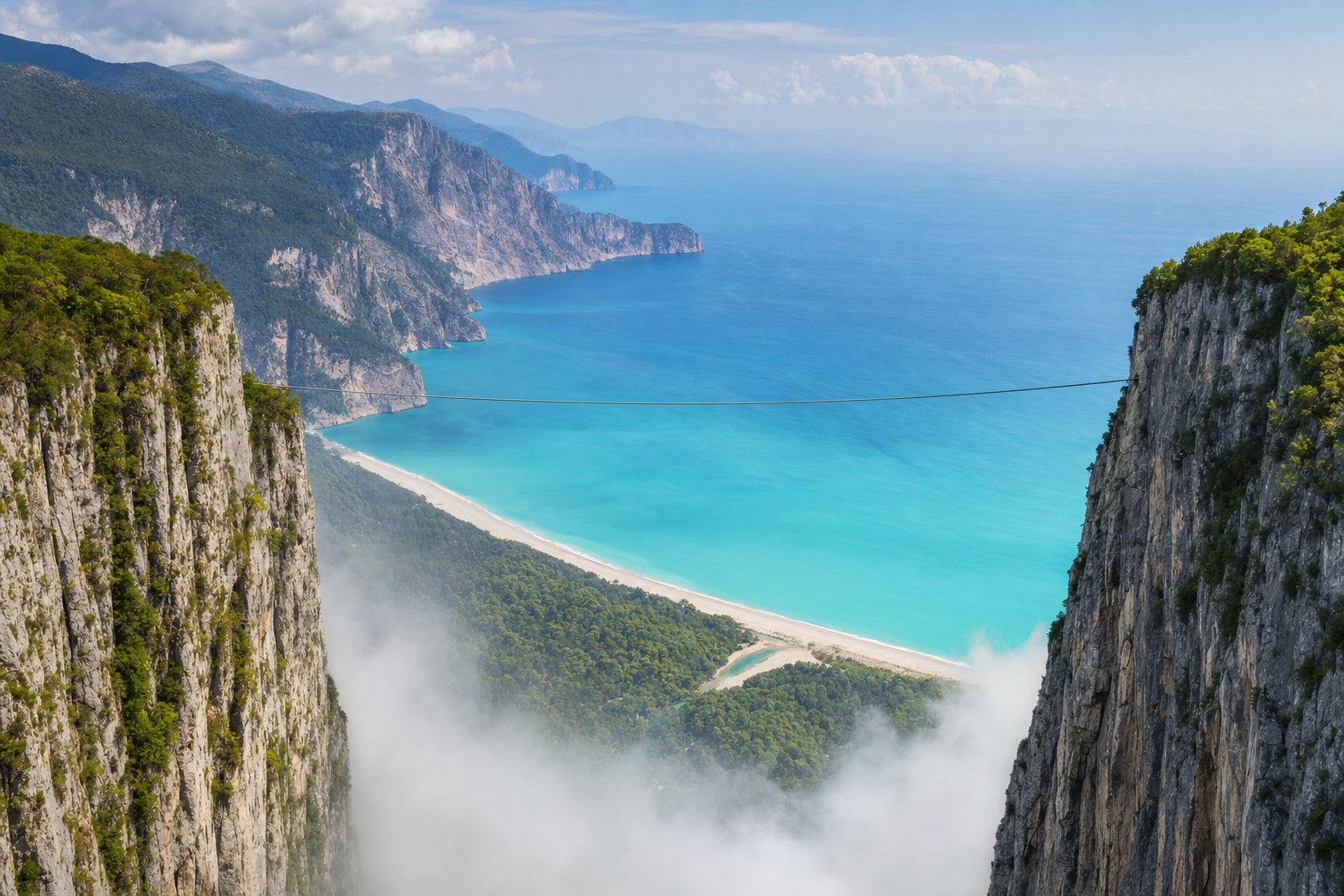
Ras Al Khaimah. The longest ziplines in the world start and end with this one: a single span down the face of the country's highest mountain, ridden prone and head-first. The undisputed record on length.
- Toroverde, The Monster2.5 km
Orocovis, Puerto Rico. Ridden prone across a valley in the island's interior, and for several years the holder of the world record before Jebel Jais.
- Copper Canyon ZipRider2.5 km
Chihuahua, Mexico. Seated rather than prone, crossing one of the deepest canyon systems in North America.
- La Tyrolienne, Val Thorens600 m drop
French Alps. Not the longest, but the greatest vertical: it starts above 3,000 m and drops roughly 600 m into the next valley.
- Canyons Zipline1.6 km
United States. The longest single line commonly cited on American courses, and the reason most domestic record claims need reading twice.
- Louisville Mega CavernUnderground
Kentucky. The craziest entry on the list by some distance: a full underground zipline course inside a former limestone mine, the only one of any size anywhere, and the answer to a question people genuinely search for.
- Icy Strait Point ZipRider1.3 km
Hoonah, Alaska. Six parallel lines dropping through rainforest to the shoreline, with a vertical of over 400 m.
- Flyin' Hawaiian1.1 km
Maui, Hawaii. At 3,600 ft the longest line the islands have had. Closed since 2024, and still listed as open by most guides.
- Eagle Flight, Nepal1.8 km
Pokhara. Marketed on a combination of length, drop and speed rather than any single record, which is the honest way to describe it.
- Zip 2000, Sun City2.0 km
South Africa. One of the earliest very long spans built for tourism, and still one of the fastest at roughly 160 km/h.
Why the numbers disagree
Four things get called longest, and the craziest claims exploit it
The longest zipline in the world is an easier claim to make than it looks: a course can advertise a record on at least four separate measures, and operators pick whichever one they win. There is the longest single span, which is the figure most people mean. There is total course length, the sum of every line, which lets a course with nine short lines beat one with a single enormous one. There is vertical drop, which favours alpine courses. And there is top speed, which depends as much on rider weight and harness position as on the cable.
Ranked by speed the order changes again, because position matters more than most lists admit. A prone, head-first harness is dramatically faster than a seated one on the same cable, which is why Jebel Jais and Toroverde quote speeds that seated courses cannot approach even on comparable spans.
So the craziest-sounding numbers are usually true on some measure and useless on the one you care about. The figures ranked above are the operator-quoted single-span lengths, converted where needed, and nothing else. Where a course is famous for a different measure, the note says which one.
Record questions
What is the longest zipline in the world?
The Jebel Jais Flight in Ras Al Khaimah, United Arab Emirates, at about 2.83 km on a single span. Riders travel head-first in a prone harness and the operator quotes speeds well over 100 km/h.
What is the longest zipline in the United States?
Around 1.6 km, on the Canyons course. Several American courses claim a national record on different measures, so read whether the claim is about a single line or a total course length.
Is there an underground zipline anywhere?
Yes. The Louisville Mega Cavern in Kentucky runs the only underground zipline of any size, entirely inside a former limestone mine, with the longest line crossing the cavern in complete darkness apart from the lighting rig.
Which zipline has the biggest drop?
La Tyrolienne at Val Thorens in the French Alps, with roughly 600 m of vertical between the launch and the landing, starting above 3,000 m at the top of the ski area.